Claude and the GDPR: the contract is in place. The open question is what Claude pulls from your tools
Team leads can see absence dates for their team.
“Are we even allowed to use Claude?” is usually the first question when a company in Germany thinks about Claude. The second comes later and matters more: what happens when Claude no longer just chats, but reaches into Personio, HubSpot or the inbox?
For both questions I read what Anthropic itself writes: contracts, privacy pages, help centre, Trust Center and developer docs, 120 pages in total, as of 12 November 2026. Plus the GDPR, the German Works Constitution Act and three publications from German data protection authorities.
Short version: for companies, the contract is in better shape than many assume. The data processing addendum applies automatically, your contract partner is an Irish company, and your content isn't used for training. There are still three things you should know. The data sits in the US, and Anthropic itself offers no EU region. Most of the controls only come with the Enterprise plan. And what Claude gets back from a connected tool isn't decided by Anthropic but by the tool. Anthropic says so itself.
I'm not a lawyer, and this isn't legal advice. It's a reading aid for the conversation with your data protection officer.
First: which Claude?
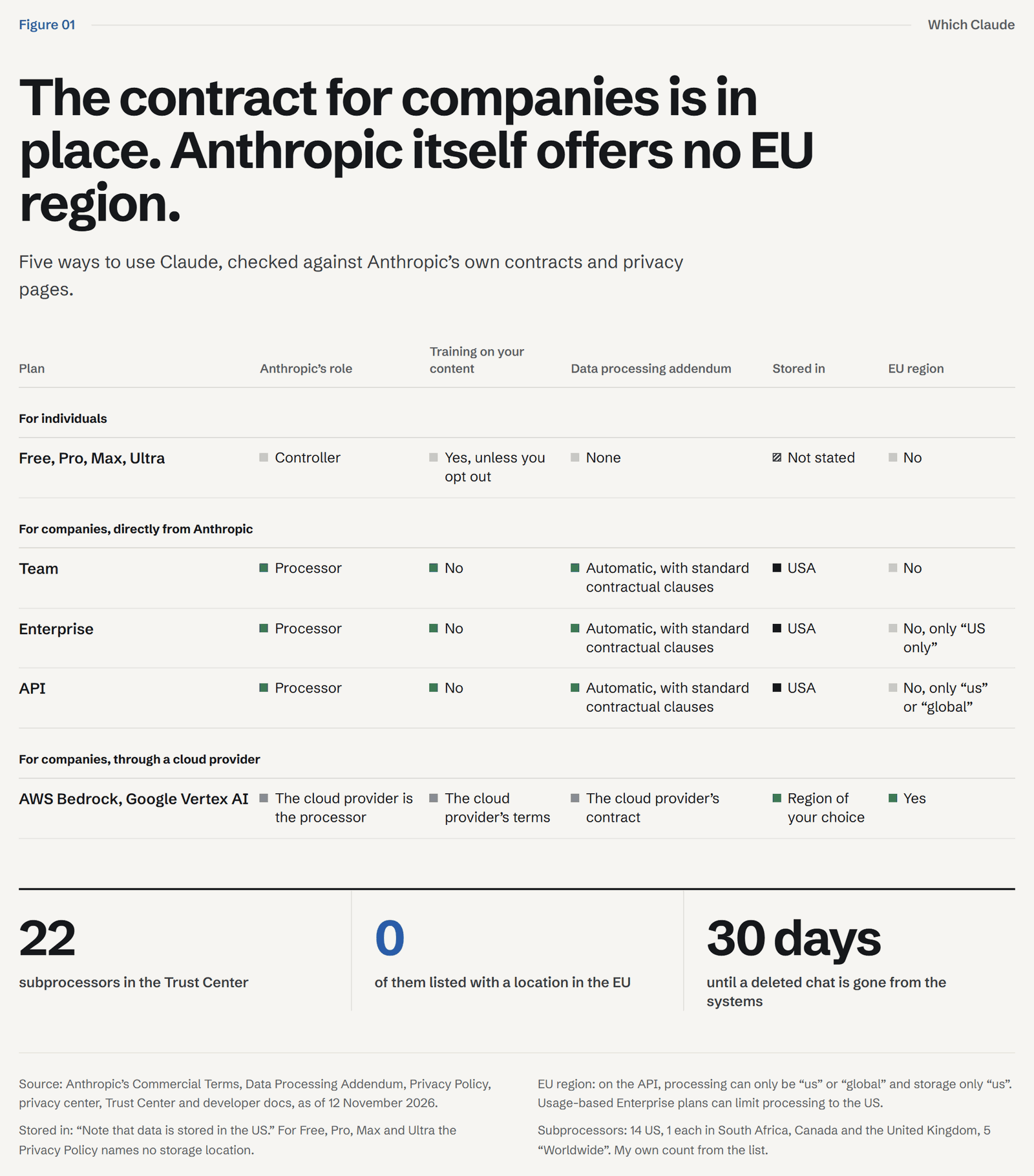
Anthropic keeps two worlds apart, and for data protection that is the most important difference.
Free, Pro, Max and Ultra are products for individuals. Here Anthropic Ireland is itself the controller. Under the Privacy Policy, inputs and outputs may be used for training “unless you opt out through your account settings”. If someone allows training, Anthropic says their data can be kept for up to 5 years for that purpose, without direct identifiers. There is no data processing addendum here: the Privacy Policy explicitly doesn't apply to content Anthropic processes for business customers.
Team, Enterprise and the API are the products for companies. Here you are the controller and Anthropic is your processor.
So the first data protection question isn't a technical one: are your people using Claude with private accounts? The data protection authority of Lower Saxony names Claude in its AI FAQ as an example of shadow AI, meaning AI used in a company without having been approved. The German Data Protection Conference recommends in its guidance (margin no. 41) that employers provide accounts for work use.
Everything else in this article is about Team, Enterprise and the API.
What Anthropic got right
On the contract, Anthropic did its homework.
The data processing addendum isn't an extra you have to ask for. According to Anthropic it is “automatically incorporated into our Commercial Terms of Service”, including the EU standard contractual clauses. That is the agreement under Art. 28 (3) GDPR which, according to the Data Protection Conference (margin no. 32), a cloud AI application often needs.
Your contract partner isn't the US company. For customers in the European Economic Area, Switzerland and the United Kingdom it is Anthropic Ireland, Limited, according to the Commercial Terms. That has been in there since the version of 14 May 2024.
Your content isn't used for training. The Commercial Terms say: “Anthropic may not train models on Customer Content from Services.” There is one exception: anyone who rates an answer with thumbs up or down sends Anthropic the whole conversation. It is stored for up to 5 years and may be used for training. An owner can switch this rating off for the whole organisation.
The rest looks solid as well. Deleted chats are gone from the systems within 30 days, and so is all customer data after the contract ends. In the data processing addendum, Anthropic commits to helping you with a data protection impact assessment and to reporting security breaches within 48 hours. New subprocessors are announced, and you have 15 days to object.
Where the data sits
This is where it gets less comfortable for German companies. Anthropic writes in its privacy centre: “Note that data is stored in the US.” By default, requests are processed in “select countries in the US, Europe, Asia and Australia”.
I found no EU region at Anthropic itself. The API has two settings: where the model runs and where the data is stored. For the first there is only “us” and “global”, for the second only “us”. Usage-based Enterprise plans can limit processing to the US, not to Europe.
According to Anthropic, a region in Europe only exists through the cloud providers, meaning AWS Bedrock and Google Vertex AI. For Microsoft Foundry the page contradicts itself: the FAQ lists Foundry for Europe, the table says “Coming soon”. If you use Claude that way, you have a different contract, though: the cloud provider is then the processor, with its own terms.
Then there are the subprocessors. The Trust Center lists 22. None of them is shown with a location in the EU: 14 are in the US, one each in South Africa, Canada and the United Kingdom, and 5 say “Worldwide”, among them Google Cloud, AWS and Microsoft Azure.
None of this makes Claude unlawful. Standard contractual clauses are explicitly provided for in Art. 46 GDPR, and Anthropic relies on them. I found no mention of the EU-U.S. Data Privacy Framework on Anthropic's pages. But it remains a transfer to a third country, and the Data Protection Conference points to Chapter V of the GDPR for that (margin no. 17). This is the part your data protection officer has to assess and document.
Two things are worth knowing here. Without a custom period, chats in Team and Enterprise stay stored until someone deletes them. And the arrangement under which Anthropic stores nothing at all only exists for the API, and only with approval. The Team and Enterprise interfaces are “not ZDR-eligible”, according to the docs.
What only comes with Enterprise
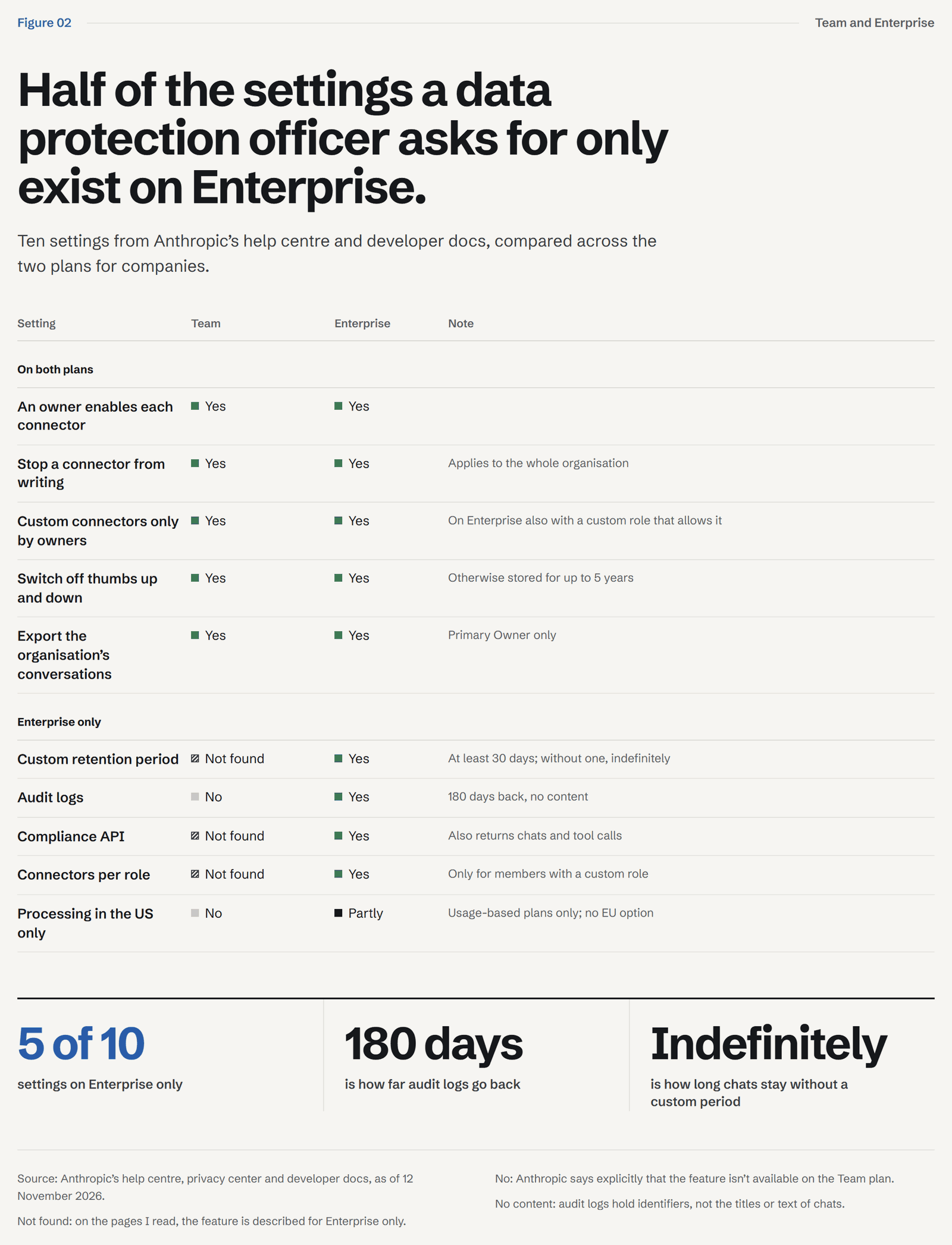
Many smaller companies start on the Team plan. But a large part of what a data protection officer wants to see is only described for Enterprise in Anthropic's docs.
- Retention periods. Custom periods are “available to Enterprise plan customers”, says Anthropic, with a minimum of 30 days. Without one: “data is retained indefinitely”. I found no such setting for the Team plan.
- Seeing what happened. Audit logs exist “for Enterprise organizations only”. They go back 180 days and hold no content, only identifiers. The Compliance API, which can also read chats, is likewise only named for Enterprise.
- Connectors per role. Which role may use which connector can only be set with custom roles, and those only exist on Enterprise.
The Team plan still has something: an owner has to enable every connector, can stop a connector from writing, and can switch off the ratings. On Team, only owners can add custom connectors. On Enterprise, people with a custom role that allows it can add them too.
For a works council, another point matters. On both plans the Primary Owner can export the organisation's conversations. Anthropic's Service Specific Terms oblige you to tell your people that the company has access to their data. Whether that triggers co-determination under Section 87 (1) no. 6 of the Works Constitution Act is something to discuss with the works council. The Data Protection Conference advises checking whether it should be involved (margin no. 31).
The part the contract doesn't cover: connectors
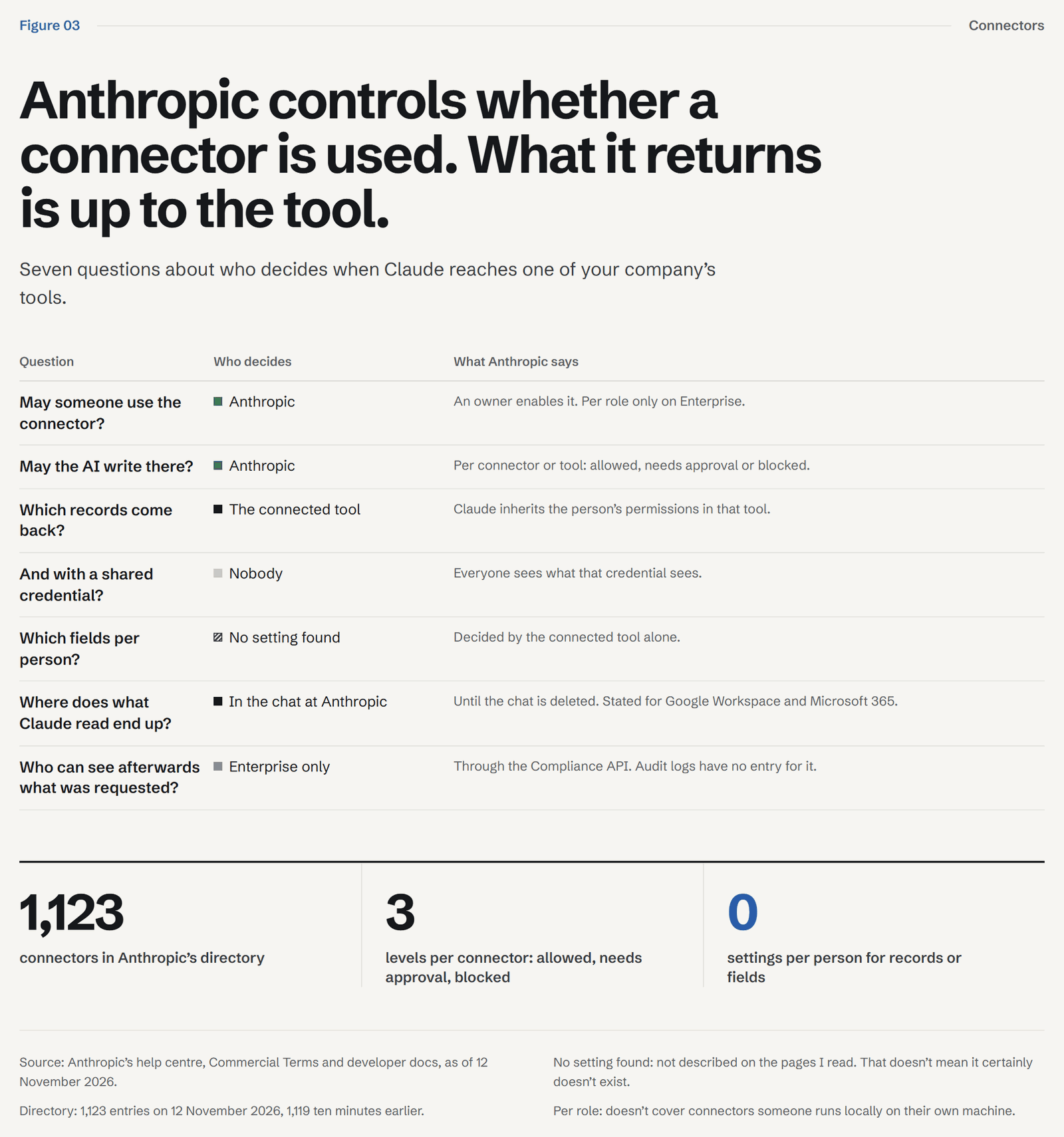
So far, this has been about chats. The real difference comes when Claude reaches your tools. That happens through connectors, technically through MCP. Anthropic's directory counted 1,123 of them on 12 November, and every company can add its own.
Again, first what is done well. On Team and Enterprise an owner has to enable a connector, and after that each person signs in individually. Anthropic writes: “Claude inherits each person’s permissions from the connected service. If someone can’t access a specific file, channel, or record in the source system, the connector can’t reach it from Claude either.” Someone who only sees their own deals in HubSpot only gets those through Claude.
Anthropic names the limits itself.
Shared credentials. The same paragraph says: “Custom connectors that use a shared credential reach whatever that credential can access.” And the guide to custom connectors: “everyone who uses the connector reaches the service with that same credential”. That is exactly the situation of the tools in my finance post. sevDesk, for example, has only one token per administrator. If you connect a tool like that yourself, everyone who uses the connector gets the admin's view.
What Claude reads stays in the chat. For the Google Workspace connectors, Anthropic writes: “Data retrieved while using connectors is stored on Anthropic servers” and “retained with its associated chat”. It says something similar for Microsoft 365 and for enterprise search. Together with the section above, that means: what Claude pulls from your HR system then sits in a chat in the US, and without a custom period for as long as nobody deletes the chat. I found no general statement covering all connectors.
No rule per person. The finest level I found at Anthropic is: allow a connector or a single tool, allow it only with approval, or block it. For the whole organisation that works on Team and Enterprise, per role only on Enterprise, and there not for connectors someone runs locally on their own machine. I found no setting that decides which records or fields a connector returns for which person. That is decided by the connected tool alone.
The responsibility stays with you. The Commercial Terms say that features from third parties “are not Services” and that Anthropic isn't responsible for them. Even the “Verified” label in the directory is explicitly not a security review, according to Anthropic (“It isn’t a security audit”), and the provider can change its connector after the review.
Seeing what happened. The list of events that audit logs record has no entry for a connector being used. What Claude requested in a tool is only visible through the content the Compliance API returns, so on Enterprise.
Personal data. In the data processing addendum, the line for special categories of personal data says: “None”. And in an article about training, Anthropic writes: “we encourage our users not to use our products and services to process personal data.” An HR system consists of personal data, often including health data such as sick notes. That isn't a ban. But it is a point to settle with your data protection officer before you connect a tool like that.
None of this is a flaw on Anthropic's side. A provider of AI models can't know that a team lead in Hamburg may see their team's absences but not the salaries. That knowledge lives in your company. The Data Protection Conference makes the same point in a paper from October 2025. It is about AI systems that search internal documents, not about connectors. The observation still fits: inside the language model itself, you can't control which information particular users may access. For that, people have to be given roles.
What to settle before you connect Claude to your tools
- Are people using Claude with private accounts today, and do you know about it?
- Is the Team plan enough, or do you need custom retention periods and audit logs? Both only come with Enterprise.
- Is storage in the US acceptable for your data, and who documents that assessment?
- For each connector: does every person sign in as themselves, or does everyone share the same credentials?
- Which data comes into chats through a connector, and how long does it stay there?
- Which connector may write, not just read?
- Can you see afterwards what the AI requested in which tool?
- Are thumbs up and down switched off, and is it settled which local extensions are allowed?
Questions 4 to 7 are what I'm building Vortner for. It is an MCP gateway and sits between your AI and your tools. You set per person what the AI gets from which tool, even for tools that only know one shared login, and you see what the AI requested where. Vortner changes nothing about questions 1 to 3. Where Anthropic stores your chats is settled in your contract with Anthropic. Vortner itself runs only in the EU, but what Claude has read then sits in your chat. What changes is what gets there in the first place. If you want to try it, write to me.
How I did this
- Sources: 120 pages from Anthropic (contracts at anthropic.com/legal, privacy centre, help centre, Trust Center, developer docs), plus 8 pages of legal texts and publications from the Data Protection Conference and the data protection authority of Lower Saxony, read on 12 November 2026. Six details were checked again and corrected on 13 November. Every statement has a source with a quote. The quotes were checked against the page text.
- Versions: Commercial Terms of 17 June 2025, Data Processing Addendum of 24 February 2025, Privacy Policy of 10 September 2026, Service Specific Terms of 31 August 2026.
- “Not found” means not found on the pages I read, not that it certainly doesn't exist. That applies to an EU region at Anthropic itself, the Data Privacy Framework, a setting per person for records or fields, a general statement on how connector data is stored, an audit log event for a connector being used, and custom retention periods on the Team plan.
- Numbers: the connector directory showed 1,119 entries on 12 November and 1,123 ten minutes later. The 22 subprocessors and their locations come from the Trust Center. The split by country is my own count.
- Irish company: the date comes from comparing two archived versions of the Commercial Terms. The version of 1 May 2024 names only Anthropic, PBC, the one of 14 May 2024 also Anthropic Ireland, Limited.
- Contradictions in Anthropic's own sources: the docs call the Gmail connector read only, while the help centre says Claude can also send emails after approval. The page on regional offerings lists Microsoft Foundry for Europe as available in the FAQ and as “Coming soon” in the table. The Commercial Terms rule out training without qualification, while the privacy centre names the exception for ratings. In each case I went with the more specific source and named the contradiction here.
- Not covered: ChatGPT and Copilot. They come with different contracts.
- Not tested: I didn't set up a Team or Enterprise organisation for this article. Everything above is based on public documentation.